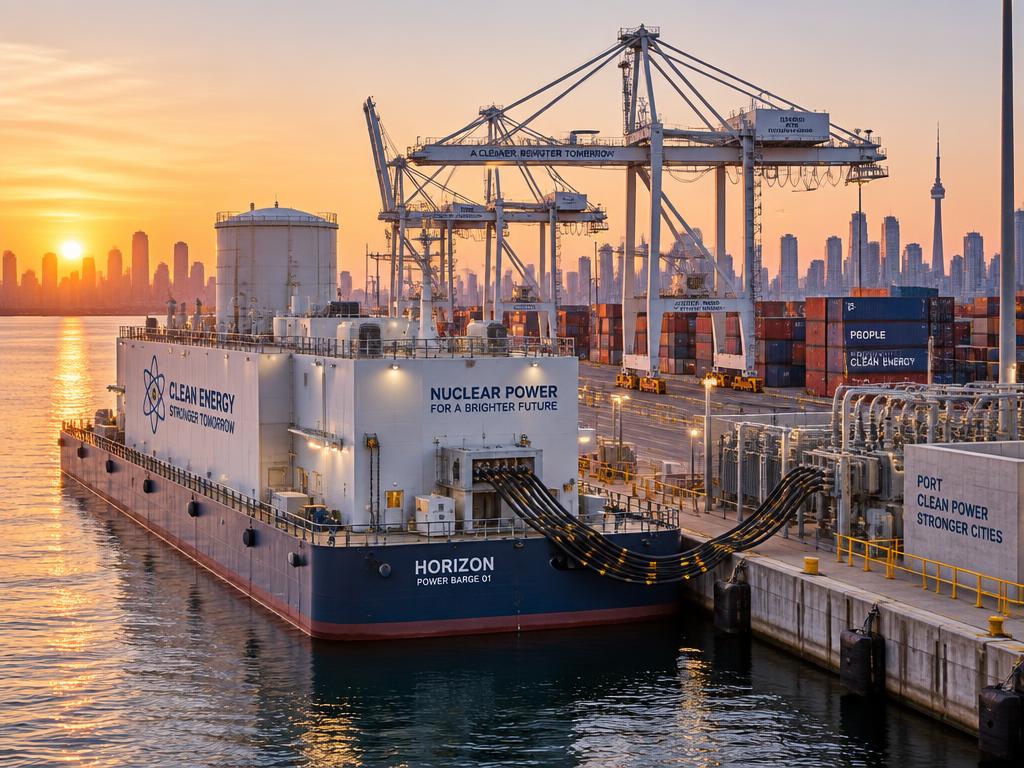
 USE-001
Ports that breathe
Moored along the quay, cables bridged to the terminal substation. Cranes, reefers and berthed ships run on silent, emission-free power instead of burning fuel at the dock — and the neighborhood wakes up to cleaner air.
A new dawn for port and city energy
A power barge tied up at your quay, feeding the port, its tugs and the city a clean 40 MWe from one container-scale molten salt reactor. We begin on a ship that stands still — and prove, year by quiet year, that the same core can safely go to sea.
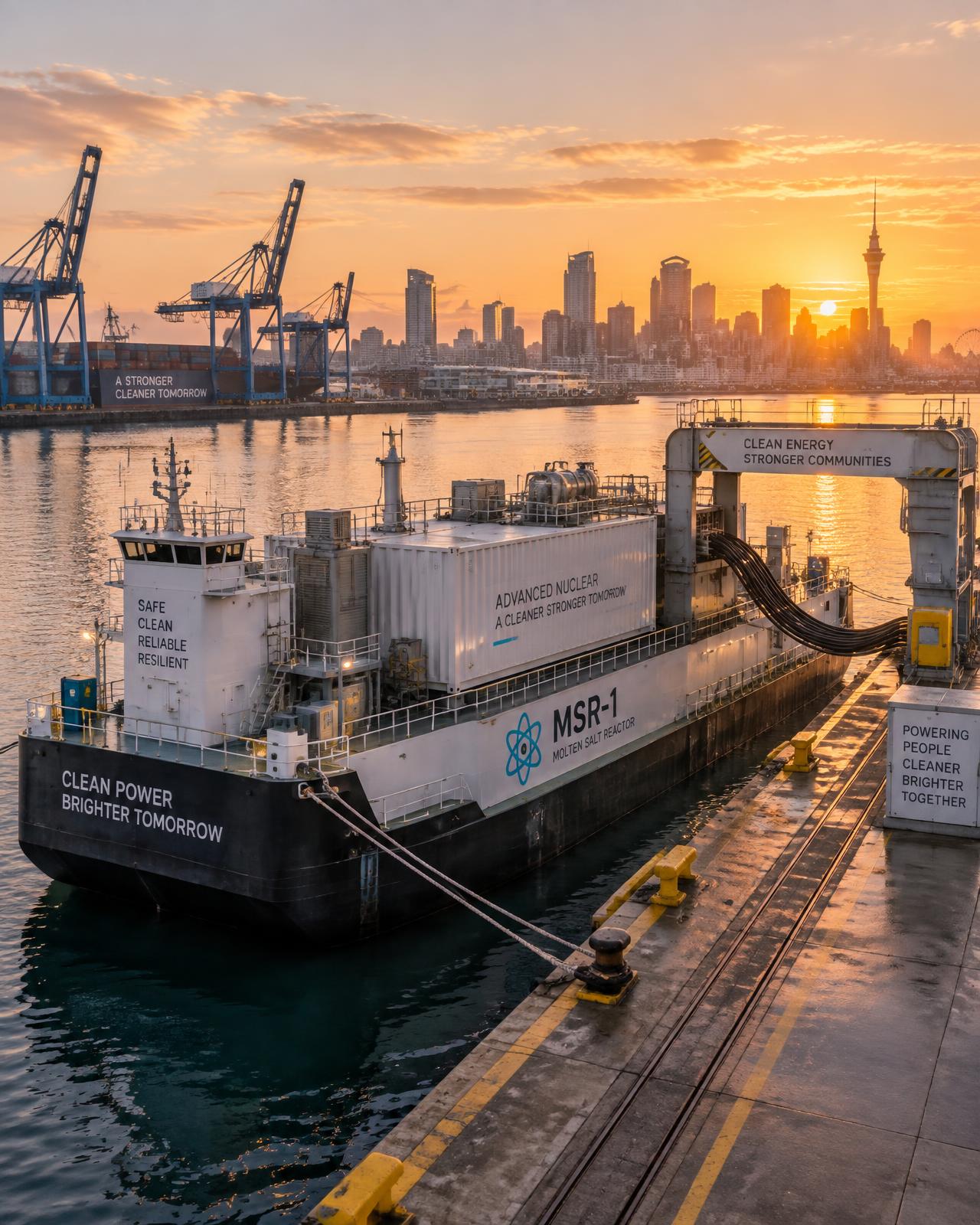 PB-MSR-40 · Moored Alongside
Delivering
40 MWe · clean
To shore
110 kV
Doc. PB-MSR-40 / Rev. 05.26
Scale 1:900 · Moored Elevation
§ How it works
The fastest honest route to nuclear power at sea runs through a ship that isn't moving yet. Prove it at the quay, then let it sail.
We start where the sea stands still: tied up alongside the quay. No roll, no pitch, no motion in the salt loop — the calmest possible place to prove a reactor, shift after shift, before anything ever sails.
One cable bridge to the quay substation. Cranes, reefers and berthed ships stop burning fuel, electric tugs top up between jobs, and whatever is left flows straight into the city grid.
Liquid salt at ordinary pressure — nothing to explode, and if it ever runs hot, gravity drains it into a safe tank. Every docked year of that behaviour is what earns the next step: the same core, certified to move.
§ The road to sea
Nobody should put a reactor to sea on a promise. So we earn it in order — still water, sheltered water, open water — and the harbor gets clean power the whole way.
01 — Moored at the quay
The barge lies still alongside, cables ashore. Port and city draw clean power while every system is logged in the calmest conditions a reactor can be asked to work in.
02 — Sheltered water
Same hull, same core, now riding a real swell inside the breakwater. Motion, list and sloshing are measured against years of dockside data before anything changes.
03 — Under way at sea
A reactor certified to make power while the ship moves — the step that puts clean nuclear energy into shipping itself. Everything before it exists to earn this one.
§ Where it goes
The PB-MSR-40 is built for years of quiet service alongside an ordinary quay, then gentle redeployment under IMO tow protocols — each berth another season of proof toward power at sea.
USE-001Moored along the quay, cables bridged to the terminal substation. Cranes, reefers and berthed ships run on silent, emission-free power instead of burning fuel at the dock — and the neighborhood wakes up to cleaner air.
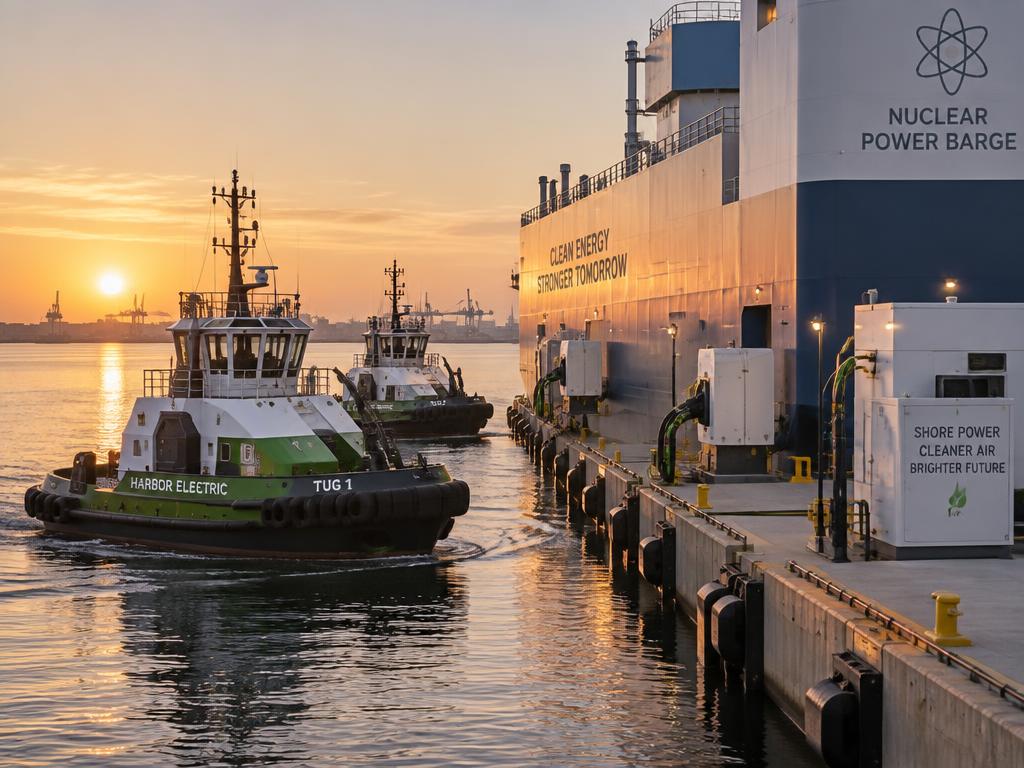 USE-002
Two fast-charge couplers on the barge's outboard face. A whole electric tug fleet swaps energy between shifts in under 45 minutes without ever leaning on the local grid.
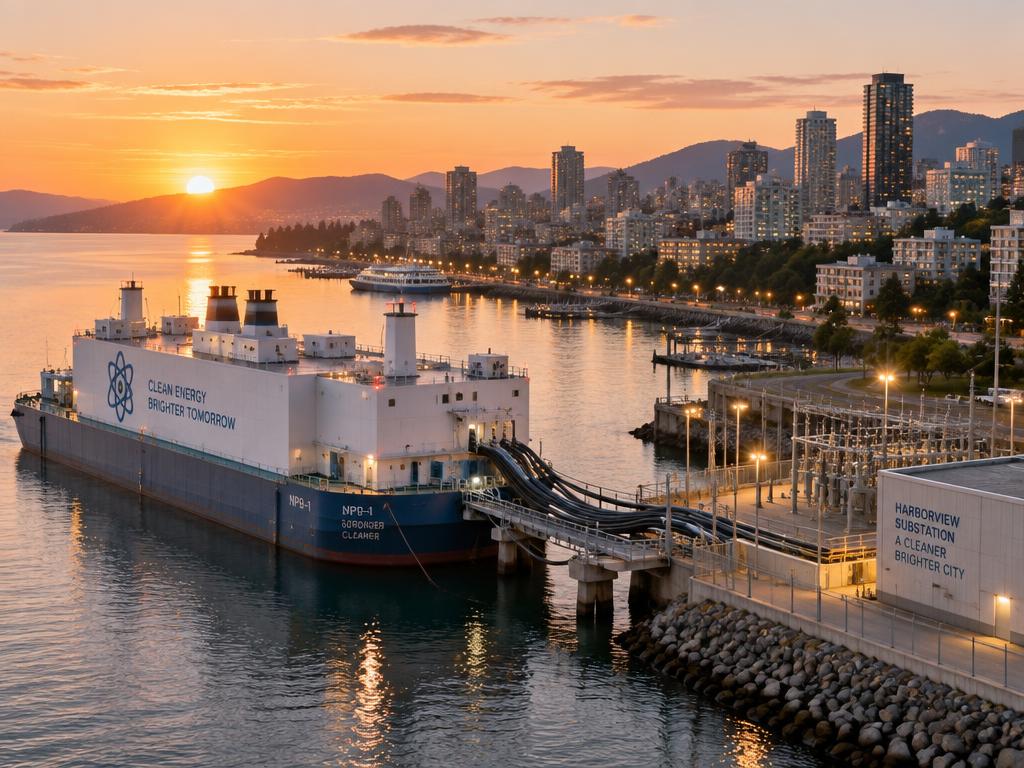 USE-003
Whatever the port doesn't use flows into the municipal grid — steady baseload for homes, hospitals and water treatment, delivered from a hull that never leaves its berth.
§ By the numbers
PB-MSR-40 is a moored power barge: a steel hull tied up alongside an ordinary quay, carrying a container-scale molten salt reactor and feeding the port and the city through one cable bridge. Built for a 60-year hull life, with hot-swappable reactor modules every twelve — and designed from the keel up to one day do the same underway.
One Motherbarge ≈ 180,000 households breathing cleaner air every single morning.
§ Four Promises to the Harbor
Passive Drain
If it ever overheats, gravity gently pours the fuel into a safe tank. No pumps, no power needed.
Atmospheric
No high-pressure containment, no explosive failure mode — just liquid salt at ordinary pressure.
Moored & Steady
Tied up alongside, the hull barely moves. Every system is proven in still water long before it ever sails.
IAEA Aligned
Certified under the floating-plant safety framework, with the port authority on site.